The Property Institute (TPI) – Outcome Appeals
Help & Guides
Useful information about The Property Institute (TPI) – Outcome Appeals.
Choose Scheme
- ABC+ Warranty Consumer Code for New Homes
- ABCD
- Aedis Independent Alternative Dispute Resolution Service (AIADRS)
- Ark Insurance Group
- Aviation (Flights)
- Benenden Health
- Build-Zone Structural Warranty Policies
- Cavity Wall Installation (CIGA & IAA)
- Consumer Code for Home Builders Independent Dispute Resolution
- Consumer Code for New Homes
- Education (ICASO)
- Gambling
- Holiday and Residential Parks Association (HARPA)
- Homes England
- ICW Consumer Code for New Homes
- Jewellers
- Lotteries
- NAFD Resolve
- National Custom & Self Build Association (NaCSBA)
- Package Holiday
- Postal Redress (POSTRS)
- Private Healthcare Mediation
- Regulator of Social Housing
- Renewables
- Solicitors
- Storage
- Surveyors (RICS)
- Telecoms (CISAS)
- The Glazing Arbitration Scheme
- Water Redress (WATRS)
Frequently asked questions
How you can bring an appeal
What is the Service for?
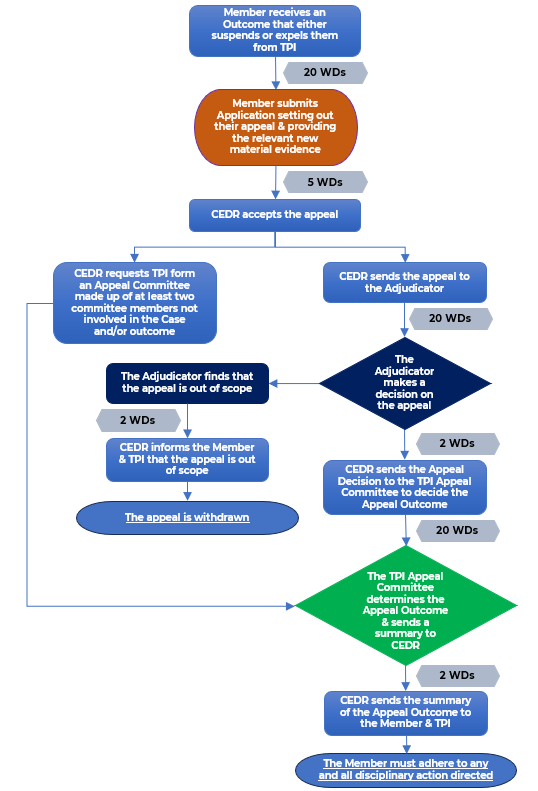
The Service is a way for a TPI Member to appeal against an outcome from TPI’s Complaints Committee that they are suspended or expelled from TPI.
This is done by looking at the original case and whether or not the Member has shown that the ground of appeal applies.
When can an appeal be brought to the Service?
You must have first received an outcome from TPI’s Complaints Committee that you have been suspended or expelled from TPI.
You will need to submit your appeal within 28 days of receiving that outcome from TPI’s Complaints Committee.
You can only appeal the outcome if you have a valid ground of appeal. The only permissible ground of appeal is that there is new and material evidence that wasn’t available at the time the matter was originally heard/when the outcome was issued.
The new evidence will only be considered:
- where there is a reasonable explanation why this evidence wasn’t provided originally, before the outcome was issued; and
- where there is more than a negligible chance that this new evidence will have a material impact on whether or not you should be suspended or expelled; and
- the evidence would have been admissible at the time the matter was originally considered.
How do I apply to the Service?
To apply to use the Service, you should complete CEDR’s application form. This can be found on the website or by contacting CEDR at
You will need to send to CEDR the completed application form, with the original case number included. Instructions of how to send this to CEDR will be on the application form.
If you require any special assistance with your application, you can contact CEDR and reasonable adjustments will be made in line with the CEDR reasonable adjustments policy, which can be found on the CEDR website.
What should I include in my application?
- A description of the new evidence that you believe is material to the outcome;
- An explanation as to why the evidence wasn’t provided originally;
- The new and material evidence on which you are relying.
What types of appeals are not suitable for the Service?
- Where the appeal has been submitted more than 28 calendar days after the outcome was issued;
- Where the appeal concerns an outcome where you were not either suspended or expelled from TPI;
- Appeals that are frivolous and/or vexatious;
- Where dealing with your appeal would seriously impair the effective operation of CEDR.
The outcome
Who will decide the outcome of the case?
The adjudication will be undertaken by an independent adjudicator appointed by CEDR from its Adjudication Panel.
The appointed adjudicator will consider the information received from the Member. They will then decide whether or not the Member has raised a valid ground of appeal.
If they find that a valid ground of appeal has been raised, they will recommend that TPI’s Appeals Committee hears the appeal. If they find that no valid ground of appeal has been raised, they will recommend that TPI’s Appeals Committee does not hear the appeal.
It is, however, TPI’s Appeals Committee who has final say as to whether or not it hears the appeal. The CEDR adjudicator makes a recommendation only. Therefore, it is TPI’s Appeals Committee who decide the outcome of the appeal.
Will I see the adjudicator’s recommendation?
No. The adjudicator’s recommendation will be sent to TPI’s Appeals Committee who will consider the recommendation they have made.
It will then be TPI’s Appeals Committee who decide whether to hear the appeal or not. And, if it does hear the appeal, what impact this has on the original outcome (if any).
TPI’s Appeals Committee will then produce a summary of the outcome of the appeal. It is this summary of the appeal outcome that will be sent to you.
What recommendations can the adjudicator make?
The recommendations the adjudicator can make are limited to:
- The Member’s appeal is heard, because a valid ground of appeal has been raised; OR
- The Member’s appeal is not heard, because no valid ground of appeal has been raised.
Please note that the adjudicator’s role is to decide only whether or not a valid ground of appeal has been raised.
What can the adjudicator not do?
The adjudicator cannot recommend that you receive any direct remedy such as compensation. Further, the adjudicator cannot reconsider any decision made by an Ombudsman, the Court, or other dispute resolution procedure.
What are the possible outcomes of my appeal?
It will be TPI’s Appeals Committee who have final say on the outcome of the appeal. It will consider the recommendation of the adjudicator and decide whether or not to hear the appeal.
If TPI’s Appeals Committee decide to hear the appeal, it will reach one of the following conclusions:
- The appeal is rejected, and the decision to suspend or expel the Member from TPI as set out in the original outcome remains unchanged; or
- The appeal is accepted, and the decision to suspend or expel the Member from TPI as set out in the original outcome is varied; or
- The appeal is accepted, and the decision to suspend or expel the Member from TPI as set out in the original outcome is overturned.
TPI’s Appeals Committee will produce a summary of the outcome of the appeal. This summary will be sent to you.
Are you a business?
CEDR can provide dispute resolution services for businesses in most sectors.
- Fast, and cost effective solutions
- Provided at a sustainable cost